
Every figure sourced, dated and checked. No sponsors, no positions.
We ask the same questions of every network, publish the numbers so a reader can re-weight them, and write our scores into a public record before the prices move. Soundings is the quarterly screen, issued between the 12th and 24th of January, April, July and October; the chart pack re-cuts it monthly; deep dives take one network at a time. Hosted from Charleston, South Carolina.
Soundings · Issue 1
Free. The research note and its companion chartbook, locked October 19, 2026. Read them, check them, keep them.
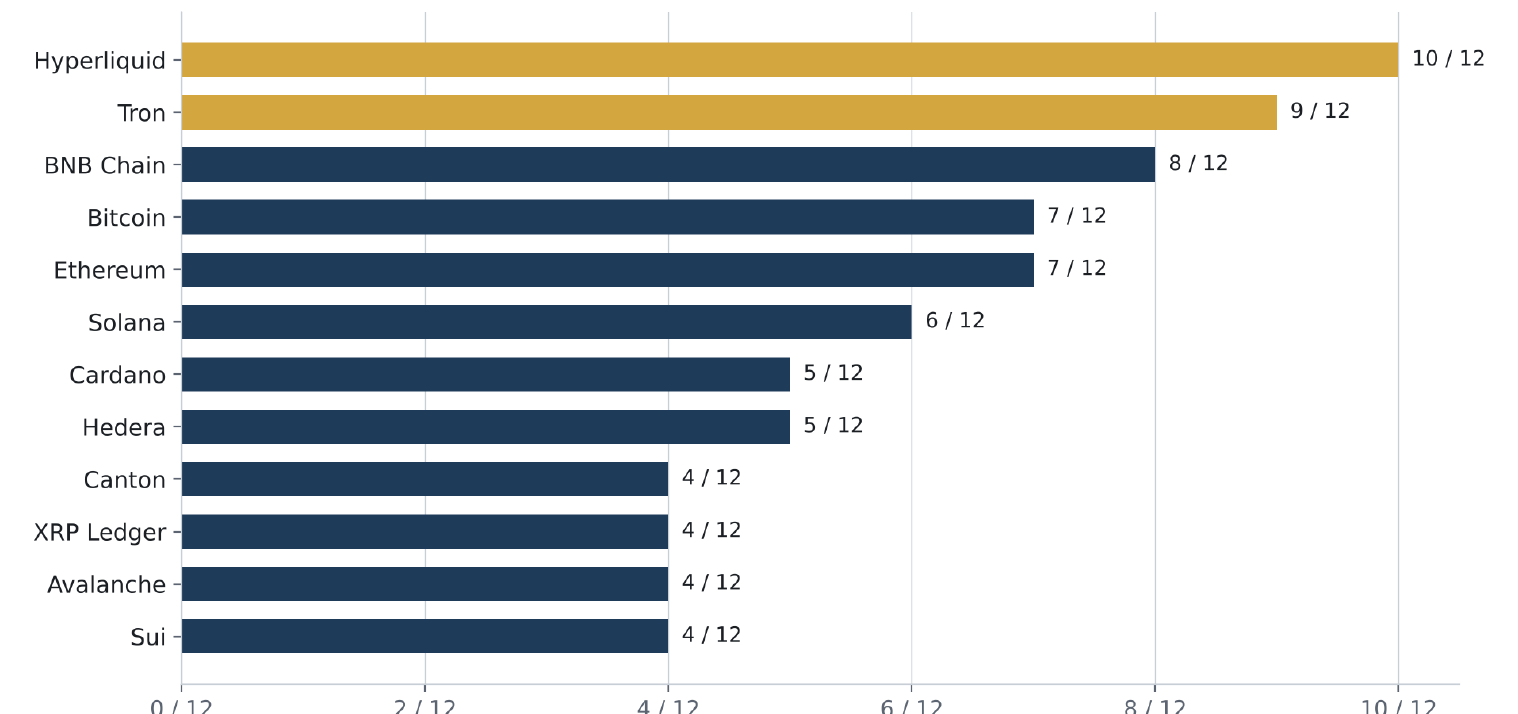
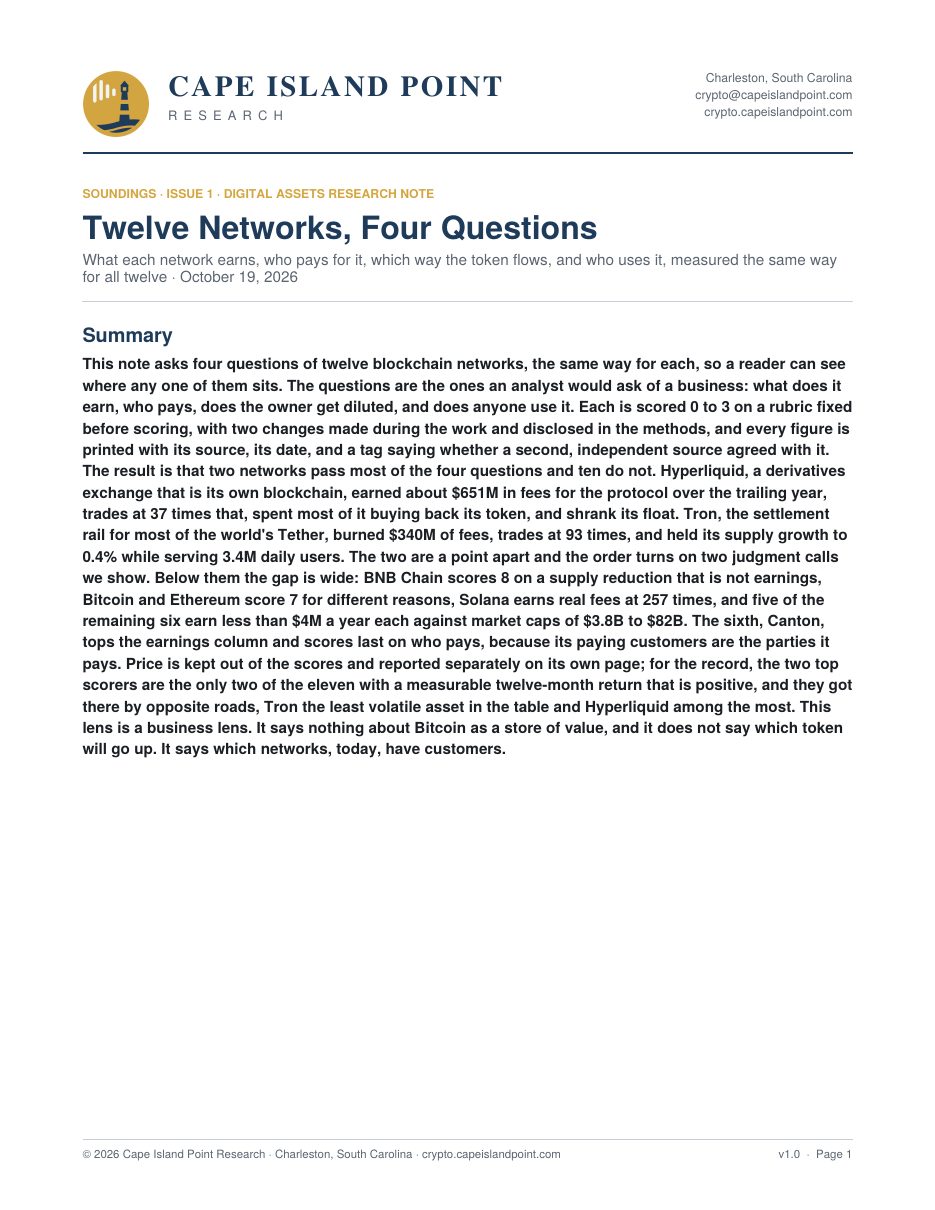
Twelve Networks, Four Questions
What each network earns, who pays for it, which way the token flows, and who uses it, measured the same way for Bitcoin, Ethereum, BNB Chain, Solana, Tron, XRP Ledger, Cardano, Avalanche, Sui, Hedera, Hyperliquid and Canton.
- Every figure with its source, date and a confidence tag; where providers disagree, both are printed
- The places a reasonable analyst would score differently, with the ranking under each alternative
- Price, volatility and drawdown reported alongside, never scored
- A registered hypothesis and a public ledger, so the scores can be checked against what happens next
 Page 1
Issue 1 Chartbook
One chart per page. The screen in seven charts, then one page for each network: three years of fees, a year of supply, users and price, with the locked score in the headline. Market context closes it.
Download the chartbook (PDF, 4 MB)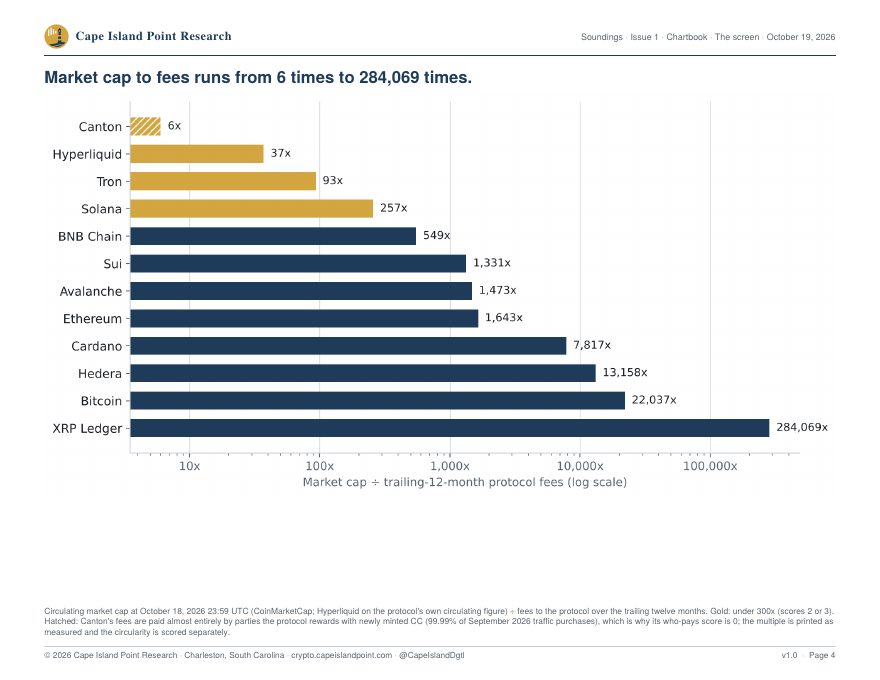 Page 4
Subscribe
One subscription, everything we publish while you hold it. Cancel any time; nothing is owed past the month you are in. The Hedera series opens Monday, October 26. Subscriptions open with the November chart pack, between November 5 and 12; Issue 1 is free now.
- Soundings, re-scored every quarter, with the ledger rows added
- The chart pack, re-cut every month, with a “what moved” page
- Every new deep dive and every update note, as they publish
- The Research Desk: a reader that answers from the papers, all year
- One network, one paper, with its chartbook and model where there is one
- Research Desk access to that paper for 30 days
- Update notes for 30 days after purchase
- Five locked reports from October 2026, as written
- The interactive HBAR price model
- Research Desk access to the series for 30 days
A subscription covers what is published while it is active, plus the current Soundings and chart pack on the day you join. Papers older than 90 days sit in the catalog at their one-off price. One-off purchases include 30 days of update notes; the subscription includes all of them. Every copy is prepared for the named recipient and carries the recipient's name and version in its footer; it arrives by email, usually within a day of purchase. Checkout is handled by Stripe, which is the seller of record and handles sales tax.
Deep dives
One network at a time. The same four questions in depth, plus the things a screen cannot hold: who the fee payers are, the unlock and emission schedule with dates, concentration, and what would change the score.
Hyperliquid
The highest score in Issue 1 and the only network in the set whose exchange is the protocol. Where the $650 million of fees comes from, where it goes, the 410 million unminted HYPE with no published schedule, the single address holding 54% of stake, and the numbers that would move the score.
Tell me when it publishesTron
Second in Issue 1: $340 million of TRX burned for bandwidth and energy, 3.4 million daily addresses, supply held within half a percent, and one customer, Tether, behind 96% of the gas.
The ETF Ledger
A free reference page, refreshed monthly. Subscribers receive the chart pack between the 5th and the 12th; the public table follows within about a week. Every figure carries the date it was published, because issuers post assets a few days after month-end.
Every US spot single-asset crypto ETF, one table, every figure sourced
61 funds across 17 assets: fee, staking, what each staking fund has actually paid out, assets and age, each figure traced to the issuer's own page and dated. Leveraged, inverse, futures and basket funds sit in a second table, never mixed in. No verdicts; the figures are the point.
Open the Ledger Download the data (CSV)What staking really costs in an Ether ETF
Six US Ether ETFs stake, and the headline fee is only part of the cost: the sponsor also keeps a share of the rewards, from 5% to 23% where disclosed. Every fee and reward share from the issuers' own documents, with the arithmetic shown.
Read the comparisonThe Hedera series · October 2026
Five reports and a model on one network, written before Soundings and locked as they stood. Sold as a set; the covers are the first page of each.
Hedera, measured against its own numbers
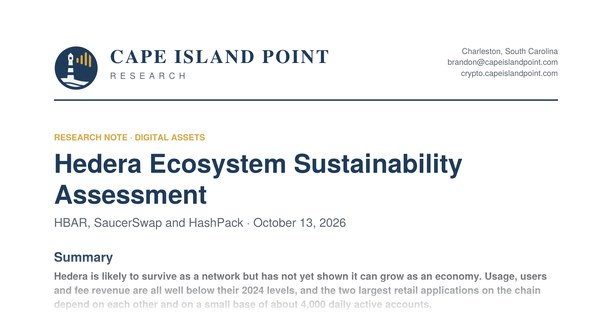
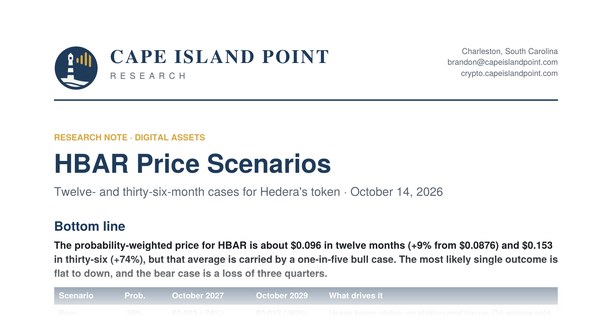
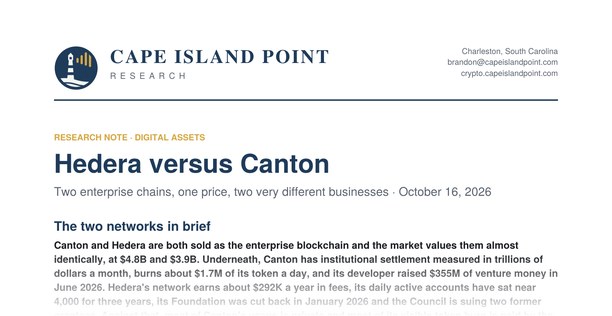
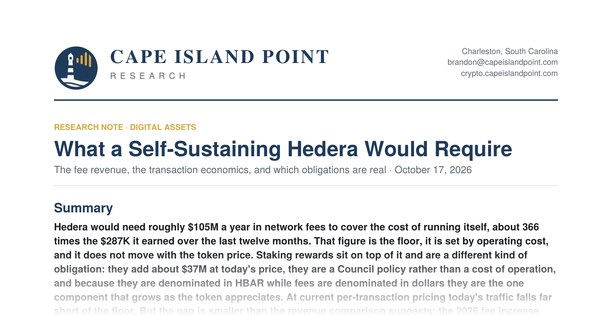
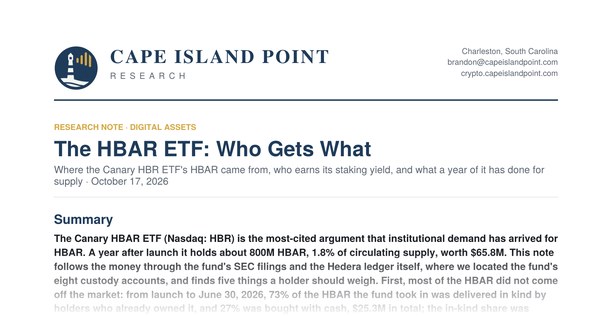
- Hedera Ecosystem Sustainability Assessment (11 pp, v1.6): usage, revenue, treasury runway, the staking pool, the Council, the grantee lawsuits, SaucerSwap and HashPack
- HBAR Price Scenarios (6 pp, v1.6): bear, base and bull at 12 and 36 months on a two-lens model
- Hedera versus Canton (7 pp, v1.6): usage, burn versus releases, who settles on each, and a 30-day census of Canton's traffic purchases
- What a Self-Sustaining Hedera Would Require (8 pp, v1.2): the fee threshold from the network's own split, and why adoption moves it away
- The HBAR ETF: Who Gets What (7 pp, v1.5): the fund's HBAR followed through SEC filings and the ledger, to the single HBAR
- HBAR Price Model (interactive): every driver editable; opens with the code in your copy of Price Scenarios
About this research
Cape Island Point Research is an independent publication based in Charleston, South Carolina. The digital-assets line applies the same method as our housing research: primary data, every figure checked against its source on a stated date, confidence tagged where two sources could share a feed, and plain language about what we could not verify. Judgments are labelled as judgments and the numbers are printed so a reader can re-weight them.
The author does not hold or trade any individual digital asset covered by this research. Any exposure he takes to the asset class will be through diversified funds that hold many assets; if such a fund holds an asset covered here, that will be stated. The October 2026 Hedera series was researched while the author held HBAR, as each report states; the position was sold on October 16, 2026, before the series was published. We accept no sponsorship from the projects covered and manage no money for anyone else.